
What Sleep Anxiety Really Is
Sleep anxiety is a cycle where the fear of not sleeping actually prevents you from sleeping. You lie in bed, your mind races with worry, and the more you try to force sleep, the more alert you become.
This is not simply insomnia. With sleep anxiety, the act of going to bed triggers dread. Your brain associates your bedroom with wakefulness and frustration rather than rest. Each restless night reinforces the pattern.
Research from the American Academy of Sleep Medicine shows that anxiety disorders and sleep problems are deeply connected. People with anxiety are significantly more likely to develop chronic sleep difficulties. For a deeper understanding, see your complete walkthrough.
Understanding that your brain has learned this response is the first step. What your brain learned, it can unlearn. The techniques that follow target both the anxiety and the sleep disruption at the same time.
| Sleep Anxiety Symptom | What Your Brain Is Doing |
|---|---|
| Racing thoughts at bedtime | Pre-frontal cortex overactive, unable to disengage from worry |
| Heart racing when lying down | Sympathetic nervous system activated instead of parasympathetic rest mode |
| Checking the clock repeatedly | Performance anxiety about sleep creating a cortisol spike |
| Dread as evening approaches | Conditioned negative association between bedroom and wakefulness |
Why Your Brain Won’t Shut Off at Night
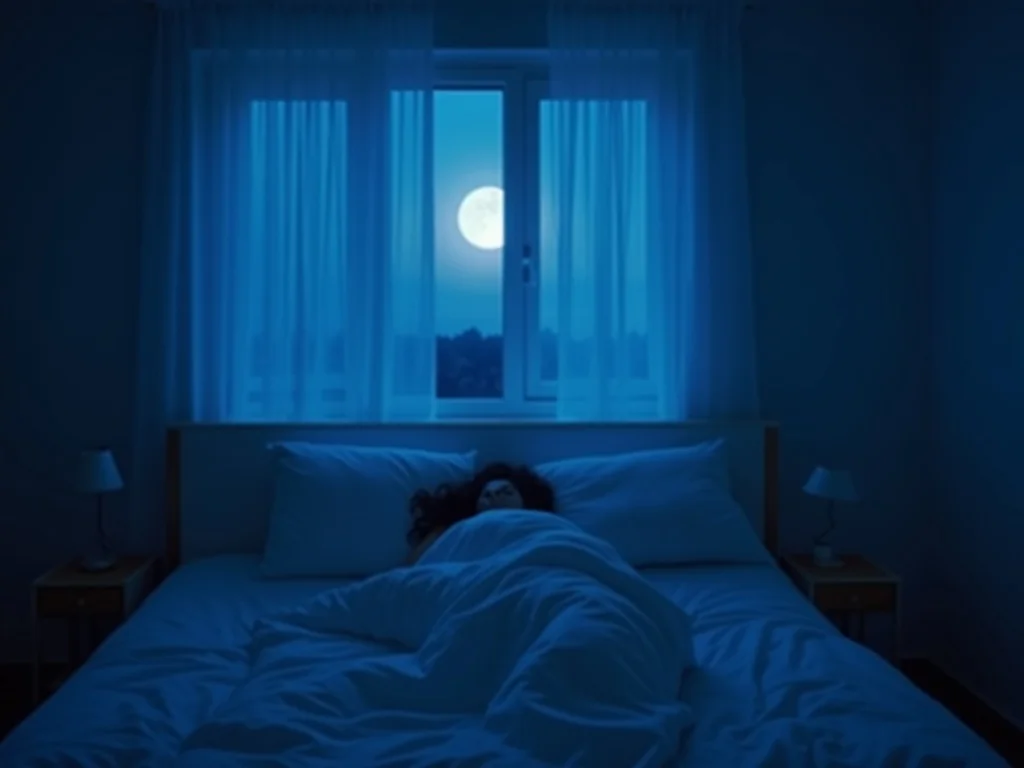
During the day, your brain stays busy with tasks, conversations, and sensory input. When you finally lie down in a quiet dark room, there is nothing left to distract you from your own thoughts.
This is when anxiety surfaces. The same mind that ignored worry all day suddenly has space to replay every concern. For people with sleep anxiety, this window becomes a nightly battleground.
Your nervous system stays in a state of hyperarousal. Cortisol levels remain elevated instead of dropping in preparation for sleep. Your body is physically ready for action when it should be winding down.
The good news is that this hyperarousal responds to specific interventions. You can train your nervous system to shift from alert mode to rest mode. It takes consistency, but the results are lasting.
Seven Strategies to Break the Sleep Anxiety Cycle
These strategies work together. Using just one might help. Using all seven consistently can transform your relationship with sleep. Start with the ones that feel most doable and add more as you build confidence.
1. The Worry Journal. Set aside fifteen minutes each evening, at least two hours before bed. Write down every worry, to-do item, and racing thought.
Close the journal and tell yourself that this is your designated worry time. When thoughts arise in bed, remind yourself you already addressed them.
2. Progressive Muscle Relaxation. Starting at your toes and working up to your forehead, tense each muscle group for five seconds and release for ten seconds. This physical release signals your nervous system that it is safe to relax.
3. The Twenty-Minute Rule. If you lie awake for twenty minutes, get out of bed. Go to another room.
Do something boring in dim light. Return only when you feel genuinely sleepy. This prevents your brain from reinforcing the bed-equals-wakefulness connection.
4. Cognitive Shuffling. This technique interrupts anxious thought loops by giving your brain a harmless distraction. Pick a word like “rest.” Think of as many words as you can that start with R, then E, then S, then T.
Visualize each object briefly. Your brain cannot ruminate and shuffle at the same time.
5. 4-7-8 Breathing. Breathe in through your nose for four seconds. Hold for seven seconds.
Exhale through your mouth for eight seconds. Repeat four times. This breathing pattern activates your parasympathetic nervous system and can lower your heart rate within minutes.
6. Morning Sunlight Exposure. Spend at least fifteen minutes outside within an hour of waking. Morning light sets your circadian rhythm and helps your body produce melatonin at the right time in the evening.
7. Bedroom Environment Reset. Remove all visible clocks. Keep the room cool.
Use blackout curtains. Reserve your bed only for sleep. Small environmental changes add up to a powerful signal that this space is for rest.
What to Do When You Wake Up Anxious in the Middle of the Night
Waking at three in the morning with a pounding heart and racing mind is one of the most isolating experiences. The world is asleep and you are alone with your panic.
First, remind yourself that this feeling will pass. It always does. Your nervous system is temporarily activated, but it cannot sustain that activation indefinitely.
Second, resist the urge to check your phone or the clock. Seeing the time adds pressure. Seeing emails or news gives your anxious brain new material to work with.
Third, try a body scan. Start at the top of your head and slowly move your attention down through your body. Notice where you hold tension.
Breathe into those areas. This redirects your focus from anxious thoughts to physical sensations.
If none of this works after twenty minutes, get up. Make a cup of herbal tea. Sit in a comfortable chair with a book that is not too engaging. Return to bed only when your eyelids feel heavy.

When Sleep Anxiety Needs Professional Support
For many people, the strategies above are enough to break the sleep anxiety cycle. But sometimes sleep anxiety is part of a larger picture that benefits from professional guidance.
Cognitive Behavioral Therapy for Insomnia is the gold standard treatment. It addresses the thoughts and behaviors that maintain sleep anxiety. Studies show that it helps the majority of people who complete a full course.
If you also experience panic attacks, daytime anxiety, or depression, a mental health professional can help you address these interconnected issues. Treating anxiety in general often improves sleep as a natural result.
Sleep specialists can also rule out physical causes like sleep apnea or restless leg syndrome. These conditions sometimes mimic or worsen sleep anxiety and require different treatment approaches.
Building a Sleep Routine That Welcomes Rest
A consistent wind-down routine is one of the most effective weapons against sleep anxiety. Your brain craves predictability. When the same sequence of calming activities happens every night, your nervous system learns that sleep is coming.
Start your routine sixty to ninety minutes before your target sleep time. Dim the lights throughout your home. Put your phone in another room or switch it to a grayscale display. Change into comfortable clothes that signal the day is over.
Choose two or three calming activities and do them in the same order every night. This could be a warm shower, gentle stretching, reading fiction, or listening to a sleep story. The specific activities matter less than the consistency.
Avoid screens in the final thirty minutes. The blue light suppresses melatonin production. If you must use a device, wear blue-light blocking glasses and keep the brightness at its lowest setting.
Temperature matters more than most people realize. Your body needs to drop its core temperature slightly to initiate sleep. Keep your bedroom between sixty and sixty-seven degrees Fahrenheit. A warm bath about ninety minutes before bed can help trigger this natural temperature drop.
Sound can also play a key role. White noise or pink noise machines mask sudden sounds that might jolt your anxious nervous system awake. Some people find that nature sounds or ambient music work better. Experiment to find what keeps your mind from fixating on silence.
FAQ
Is sleep anxiety the same as insomnia?
Sleep anxiety and insomnia overlap but are not identical. Insomnia is difficulty falling or staying asleep. Sleep anxiety specifically involves fear and dread around the act of sleeping itself. Many people have both, and treating the anxiety component often improves the insomnia.
How long does it take to break the sleep anxiety cycle?
Most people notice improvement within two to three weeks of consistent practice. Full resolution can take six to eight weeks. The key is sticking with the strategies even on nights when they do not seem to help. Your nervous system needs repeated experiences of safety in bed to unlearn the old pattern.
Can medication help with sleep anxiety?
Some medications can provide short-term relief, but they do not address the underlying learned association. Sleep specialists typically recommend behavioral approaches as the first-line treatment. Any medication decision should be made with your doctor.
Why does my anxiety get worse right when I lie down?
This happens because lying down removes all daytime distractions. Your brain suddenly has space for thoughts it was suppressing all day. The quiet and darkness also trigger a conditioned anxiety response if you have had many difficult nights in the past.
Should I avoid naps if I have sleep anxiety?
Short naps of twenty minutes or less, taken before early afternoon, are usually fine. Longer or later naps can reduce your sleep drive and make bedtime anxiety worse. If you consistently struggle at night, try eliminating naps for two weeks to see if it helps.
Conclusion
Sleep anxiety can make you feel like you are the only person awake in the world, trapped in your own racing mind while everyone else rests peacefully. You are far from alone. Millions of people share this experience, and many have found their way out.
The strategies in this guide address sleep anxiety at its root. They do not just mask symptoms. They retrain your brain to associate your bed with rest instead of dread.
Start tonight with just one technique. Maybe the worry journal. Maybe the breathing exercise. One small victory builds momentum for the next.
You deserve restful nights and peaceful mornings. They are closer than your anxious mind wants you to believe.